If your live oak is shedding leaves in March or April, your tree is not dying. Live oaks are tardily deciduous: they hold last year's leaves through winter, then drop them in spring as new growth pushes in. But those leaves, followed by stringy pollen catkins, land straight in your gutters. In Grapevine, spring — not fall — is the heaviest gutter season for homes under live oaks, which makes a spring gutter cleaning more important here than in most of the country.
Grapevine Gutter Pros helps homeowners across Grapevine, from the mature lots of Dove Crossing to the neighborhoods around Lake Grapevine, keep gutters flowing through both of North Texas's debris seasons. Live oak leaves in gutters are the spring half of that fight. Call (817) 566-8258 to schedule a spring cleanout.
Key takeaways: Live oaks drop leaves March through May, not in fall. That is normal, not a dying tree. Catkins mat together and clog gutters fast in spring. Plan a late-May cleaning after the drop finishes, plus a late-fall cleaning for other species.
Why Live Oaks Drop Leaves in Spring, Not Fall
Most shade trees drop leaves in autumn. Live oaks do the opposite. They keep a full canopy all winter, and when March arrives, the tree starts pushing tender new leaves. The old, worn-out leaves drop over a few messy weeks, usually March through early May. Texas A&M's plant clinic describes this as the live oak's normal annual leaf drop, and every longtime North Texas homeowner has watched it happen.
Then come the catkins. These are the long, fuzzy pollen tassels the tree's male flowers shed after pollination. They drift down in yellow-green strands, coat patios and cars, and settle into gutters by the handful. Unlike dry fall leaves, which sit loose and sometimes blow back out, catkins mat down when they get wet. A gutter full of dry live oak leaves is a nuisance. A gutter full of wet catkins is a plug.
Live oaks are the dominant shade tree across the Dallas-Fort Worth area, and Grapevine has plenty of them: the established streets around Lake Grapevine, the mature canopy in Dove Crossing, and older lots near Historic Downtown. If a live oak overhangs any part of your roof, your gutters get hit in two waves every spring — first the leaves, then the catkins.
What Catkins Do to Your Gutters
Catkins are worse for gutters than ordinary leaves, for three reasons. First, they fall in huge volume over a short window, so a gutter that was fine in February can be packed by late April. Second, they felt together when wet, forming a dense mat that seals over the gutter bottom instead of washing through. Third, they wedge into downspout elbows, which are the narrowest point in the whole system. And unlike ordinary leaves, live oak leaves in gutters rarely wash out on their own once the mat forms.
The result shows up during the first heavy spring storm: water sheets over the front edge of the gutter instead of draining, or pours over one corner while the rest of the run looks fine. Homeowners often assume the gutter is broken. Usually it is just full. A spring cleanout timed after the catkins finish — typically late May — clears the whole mess at once instead of paying for two visits.
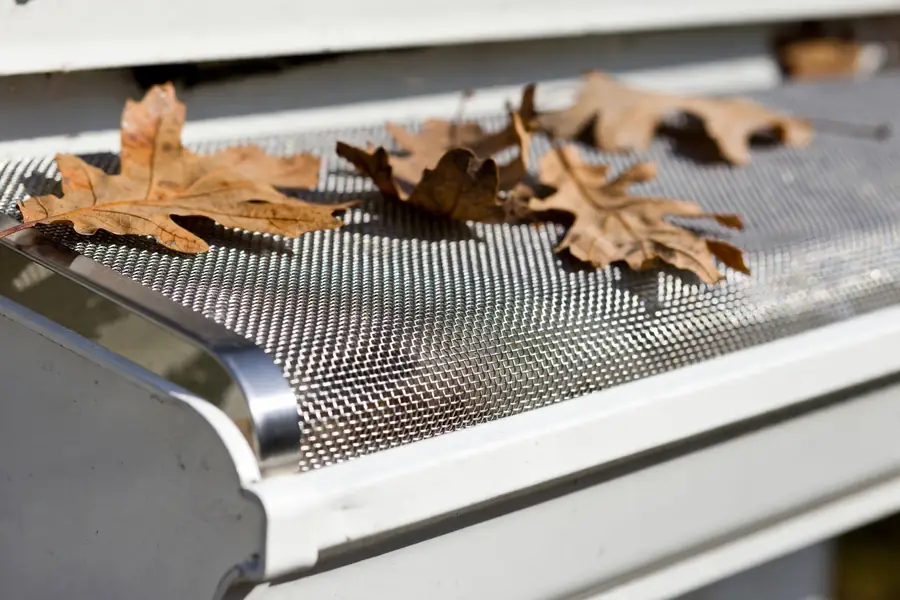
One more catkin quirk worth knowing: they defeat most gutter guards. Standard screens let catkins settle on top and mat over the mesh. Foam inserts absorb them into the foam, where they rot in place and are miserable to remove. Only fine micro-mesh, with openings small enough to keep the tassels out, stands up to a live oak in full shed. Our North Texas gutter guard guide compares guard types against local debris in detail.
Grapevine Has a Two-Peak Gutter Year
Here is the local fact that changes how you plan maintenance. North Texas does not have one leaf season. It has two.
The spring peak runs March through May: live oak leaf drop, catkins, and oak pollen. The fall peak runs October into early November, when pecans, red oaks, and cedar elms drop their leaves. A homeowner who cleans gutters once each fall — the standard advice in most of the country — misses half the debris load in Grapevine.
The calendar that actually works here is simple: one cleaning in late May, after the catkins are done, and one in late November, after the last fall leaves are down. Note the timing. Cleaning in October feels productive, but the pecans and red oaks are still dropping. Wait until the trees are finished, then clean once.
Signs Your Gutters Are Clogged Right Now
Spring clogs announce themselves if you know what to watch for:
- Water spilling over the gutter edge during rain. The classic sign. If water pours over the front lip in a normal storm, the channel is blocked.
- Overflow at one corner or downspout. A single clogged elbow backs up the whole run above it.
- Plants or grass sprouting in the gutter. Enough trapped soil and moisture has built up to grow things. It happens faster than you'd think.
- Gutters sagging or pulling away from the fascia. Wet oak debris is heavy. A packed gutter can weigh several times its dry weight.
- Water pooling near the foundation after storms. When gutters overflow, water dumps straight down beside the house. On Texas clay soil, it sits there.
- Staining on the siding or brick below the gutters. Overflow leaves dirty streaks that mark exactly where the blockage is.
- Birds or squirrels working the gutter line. They nest in the debris mat.
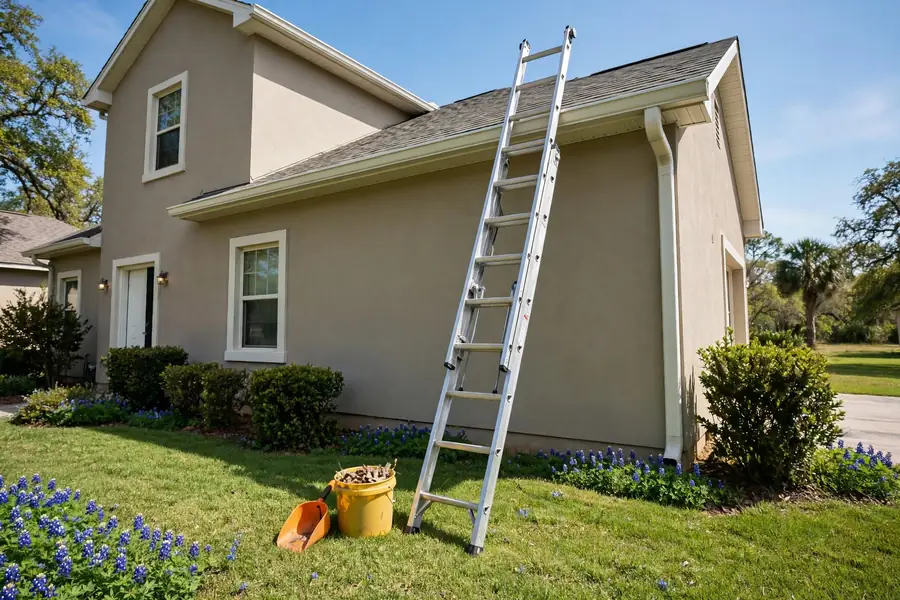
If you see two or more of these in April or May, your gutters are past due. Our gutter cleaning page covers what a full professional cleanout includes.
What a Spring Gutter Cleaning Includes
A proper spring cleanout is more than scooping leaves. The crew removes all debris from the gutter channels and bags it for disposal, then flushes each run with water toward the downspouts to confirm flow. Every downspout gets flushed and its elbows cleared, because a clean gutter with a blocked downspout still overflows.
While the gutters are open, the crew checks hanger spacing and tightness, confirms the pitch still slopes toward the downspouts, and reseals minor corner and end-cap leaks. They also check where the water goes: extensions and splash blocks should carry discharge away from the slab, not dump it at the foundation. A good cleaning ends with a short report of anything found — soft fascia, loose hangers, sections holding standing water — so small problems get fixed before the next storm turns them into big ones.
Gutter Guards and Live Oaks: An Honest Take
Guards reduce how often you clean, but live oaks are the hardest test a guard can face, and you deserve the honest version before spending money. Fine micro-mesh guards handle oak leaves and catkins well because the openings are too small for the debris to enter. Standard screens catch leaves but let catkins mat across the top, which means brushing the guards off a few times each spring. Foam and brush inserts are the worst choice under oaks: debris works into the material and cannot be flushed out.
And here is the line no guard salesman will give you: there is no such thing as a maintenance-free gutter guard. Even the best micro-mesh collects fine dust, shingle grit, and pollen film on its surface, and that layer needs brushing off once or twice a year. If anyone tells you that you will never touch your gutters again, that is a sales pitch, not advice. Guards are worth it under heavy tree cover when you buy them with honest expectations. See the guard installation page for how micro-mesh is fitted to existing gutters.
When to Call for Spring Gutter Service
If your live oaks are dropping leaves now, your gutters are filling now. Waiting until summer means the packed debris bakes into a solid mat that is harder to remove, and the spring storms will keep testing your overflow points in the meantime. Live oak leaves in gutters, left alone, become that mat within weeks. A single spring visit after the catkins finish sets you up for storm season with clear channels and flowing downspouts.
Call (817) 566-8258 to schedule a spring gutter cleaning anywhere in Grapevine, TX 76051 and 76099. We clear the leaves, the catkins, and the elbows, check the whole system while we're up there, and tell you straight what we find.
Frequently Asked Questions
Direct answers to common questions.
Why is my live oak dropping leaves in spring? Is it dying?+
No, it is not dying. Live oaks are tardily deciduous: they shed last year's leaves in spring as new growth pushes in, usually March through early May. Texas A&M's plant clinic confirms this is the tree's normal annual cycle. Yellowing followed by fresh green growth is healthy. Bare branches with no new growth by late May mean calling an arborist.
What are the fuzzy tassels falling from my oak tree?+
Those are catkins, the pollen-bearing male flowers of the oak. They fall in long strands after pollination, typically April into May in North Texas. Harmless to the tree but brutal on gutters: wet catkins felt into a dense mat that seals the gutter bottom and plugs downspout elbows. They are the main reason spring gutter cleaning matters under live oaks.
When is the best time for spring gutter cleaning in Grapevine?+
Late May, after the live oak leaf drop and catkin shed are finished. Cleaning in April means the trees refill your gutters within weeks. Cleaning in late May clears the entire spring debris load in one visit and leaves the system ready for summer storm season. Pair it with a late-November cleaning after fall leaf drop for full-year coverage.
Do gutter guards stop live oak leaves and catkins?+
Fine micro-mesh guards stop both: their tiny openings keep leaves and tassels out of the channel. Standard screens stop leaves but let catkins mat across the top, so the guards need brushing each spring. Foam and brush inserts perform worst under oaks. No guard eliminates maintenance entirely; even micro-mesh needs its surface brushed once or twice a year.
How often should gutters be cleaned under live oaks?+
Twice a year at minimum in Grapevine: once in late May after the spring shed, and once in late November after fall leaf drop. Homes directly under large oaks, or with valleys that collect debris, may need a mid-summer check too. Skipping the spring cleaning is the most common mistake, because the catkin mat causes overflow all summer.
Can clogged gutters damage my foundation?+
Yes, and this is the expensive consequence. When gutters overflow, water dumps straight down beside the house instead of being carried away. North Texas clay soil holds that water against the slab, and repeated soaking and drying cycles stress foundations over time. Keeping gutters and downspouts clear is one of the cheapest forms of foundation protection a homeowner can buy.
Should I clean my own gutters or hire someone?+
Single-story gutters with safe ladder footing are a reasonable DIY job if you are comfortable on a ladder. Two-story homes, steep roofs, or gutters you cannot reach safely are pro jobs: ladder falls send thousands to emergency rooms yearly. A pro cleaning also adds downspout flushing and a system check DIY cleanouts skip.