When you're getting new gutters, one of the first questions an installer asks is whether you want 5-inch or 6-inch. It sounds like a small difference. It isn't. That one inch of width changes how much water your gutters can carry by roughly 40 percent, and in North Texas, where rain arrives in violent bursts rather than gentle showers, capacity is the whole game.
The 5 inch vs 6 inch gutters debate comes down to one thing: how much water your roof sends at the gutter during a North Texas storm. This guide explains what the inches measure, when each size is the right call, and how the choice plays out on real Grapevine homes. Grapevine Gutter Pros sizes gutters for Texas storms every day: call (817) 566-8258 and we'll measure your roof and recommend honestly.
Key takeaways: 6-inch gutters carry significantly more water than 5-inch, the right call for steep roofs and big Texas downpours. K-style is the practical default; half round gutters suit historic architecture. Pair 6-inch gutters with 3x4 downspouts, or the extra capacity bottlenecks at the outlet.
What the Inches Actually Measure
The "5-inch" or "6-inch" label refers to the width across the top of the gutter trough, measured from the outer lip to the fascia board. It's a width measurement, but what you actually care about is capacity: how much water the trough can hold and move before it overflows.
A 6-inch K-style gutter holds about 40 percent more water than a 5-inch one. The bigger trough also pairs with larger downspouts, typically 3x4 inch instead of 2x3 inch, which move water away from the roof faster. Think of it as a system: wider gutter plus bigger downspouts equals dramatically better performance in heavy rain.
There's a common misconception that bigger gutters look bulky or commercial. On most homes, the visual difference from the street is minor. What you notice is performance: no more waterfalls over the gutter lip during spring thunderstorms, no more stained siding from chronic overflow.
5-Inch Gutters: When They're Enough
Five-inch gutters are the residential standard across America, and they're the right choice in plenty of situations:
- Single-story homes with simple rooflines. A ranch with a basic gable roof collects a manageable amount of water per run. Five-inch gutters with properly placed downspouts handle it.
- Modest roof planes. Smaller roof areas shed less water. If no single gutter run collects from a huge expanse of shingles, 5-inch capacity is plenty.
- Gentle to moderate roof pitches. Lower pitches release water more slowly, giving the gutter time to drain. Steep pitches are a different story, covered below.
- Homes without overflow history. If your current 5-inch gutters never overflow and the problems are age or damage rather than capacity, replacing like-for-like is sensible.
- Tight budgets with straightforward needs. Six-inch costs more per foot in material. When the roof doesn't demand the extra capacity, there's no reason to pay for it.
Five-inch gutters are not the "cheap option." They're the correct option for homes whose roofs don't overwhelm them. Most of the 5-inch gutters failing in Grapevine aren't failing because of their size. They're failing because they're old, clogged, badly pitched, or starved of downspouts.
6-Inch Gutters: When You Need the Extra Capacity
Six-inch gutters earn their keep when the roof sends more water than a 5-inch trough can move. The triggers:
- Steep roof pitches. Water accelerates down a steep pitch and hits the gutter as a sheet rather than a trickle. The gutter needs volume to catch it before it overshoots. Many Grapevine two-stories have pitches steep enough to matter.
- Large roof planes. A big uninterrupted expanse of roof funnels a lot of water into one run. Long runs on large homes, especially with valleys concentrating flow, overwhelm 5-inch gutters in a downpour.
- Valleys dumping into short runs. A valley acts like a funnel, collecting water from two roof planes and delivering it to one spot. If that spot has a short 5-inch run with one downspout, overflow is almost guaranteed in heavy rain.
- History of overflow. Stained siding, washed-out mulch beds, and water pouring over the gutter lip during storms are capacity complaints. If the gutters are otherwise sound and correctly pitched but still overflow, size is the problem.
- Texas downpours. Our storms routinely drop an inch or two of rain per hour. Systems sized for milder climates fail here. When in doubt in North Texas, capacity is cheap insurance.
The cost difference is real but modest relative to the whole job: more metal per foot and larger downspouts. Our cost guide explains how sizing fits into the overall quote as one factor among several.
5-Inch vs. 6-Inch Gutters: Side-by-Side Comparison
| 5-inch gutters | 6-inch gutters | |
|---|---|---|
| Trough width | 5 inches | 6 inches |
| Water capacity | Standard | ~40% more |
| Typical downspout | 2x3 inch | 3x4 inch |
| Best for | Single-story, simple roofs, modest roof planes | Steep roofs, large roof areas, valleys, heavy rain zones |
| Material cost | Lower per foot | Higher per foot (more metal) |
| Appearance | Slimmer profile | Slightly bolder, barely noticeable from street |
| Common in | Most existing Grapevine homes | New installs on larger or steeper homes |
What Size Do Grapevine Homes Usually Need?
Grapevine's housing stock leans toward the conditions that favor 6-inch gutters: two-story construction, moderately steep pitches, and large roof planes are common from the 1980s builds through the 2000s subdivisions. Add our storm pattern, intense bursts rather than steady rain, and many homes genuinely benefit from the extra capacity. That is why the 5 inch vs 6 inch gutters question gets a 6-inch answer more often here than in calmer climates.
That said, "usually" isn't a prescription. A single-story ranch in an older part of town with a simple roofline does fine on 5-inch. A two-story in Dove Crossing with a steep pitch and a valley dumping into a 20-foot run needs 6-inch. The honest answer comes from measuring your roof area, noting the pitch, and looking at how the current gutters behave in heavy rain. Any installer who recommends a size without measuring is guessing.
One more local note: homes near Grapevine Lake catch stronger wind-driven rain, which pushes water into gutters harder and faster. Wind exposure is a legitimate input to the sizing decision, and it's something a local installer accounts for that a national call center won't. Newer subdivisions with larger, more complex rooflines tilt further toward 6-inch, while the older ranch-style pockets of the city remain classic 5-inch territory.
K-Style vs. Half-Round Profiles: The Shape Question
Size isn't the only choice. Gutter profile, the shape of the trough, matters too.
K-style is the default on American homes. Its flat back mounts flush to the fascia, the front has a decorative ogee curve, and it carries more water per inch of width than other shapes. Nearly every 5-inch and 6-inch comparison you've read assumes K-style. It's the practical choice for most Grapevine homes.
Half-round is the traditional shape: a smooth half-circle trough, often seen on historic homes and high-end builds. Half round gutters have a classic look that suits certain architecture, particularly in areas like Historic Downtown Grapevine where the streetscape rewards period details. Half-round carries less water than K-style at the same width, so sizing up matters more, and it typically costs more because it's a specialty product with fewer installers.
For most homeowners, the decision tree is simple: K-style unless the architecture calls for half round gutters. If you're in a historic district or a home where the gutters are a visible design element, half-round is worth discussing, and round downspouts pair naturally with half round gutters for a cohesive traditional look. Otherwise, put the decision energy into size and downspout placement, which affect performance far more than profile.
Downspout Pairing: The Other Half of Capacity
A 6-inch gutter with undersized downspouts is like a wide highway feeding a one-lane bridge. The standard pairing is 3x4-inch downspouts with 6-inch gutters and 2x3-inch with 5-inch. The bigger downspouts move nearly twice the water, and just as importantly, they clog less: leaves and debris that jam a 2x3 outlet often pass straight through a 3x4.
Downspout count matters as much as size. A long run needs enough outlets to drain, ideally spaced so no section of gutter carries water more than about 40 feet to a downspout. When you see a quote, check both the downspout size and the count. An installer who specs 6-inch gutters but keeps the old 2x3 downspouts hasn't finished the job.
Where downspouts discharge matters too. Water that pours out at the foundation undermines the whole point of the system. Extensions that carry water several feet from the house, or tie-ins to underground drainage, are part of capacity planning, not extras. Our clay soil makes this non-negotiable: water at the slab means foundation movement eventually.
Fascia Compatibility
One practical question: will 6-inch gutters fit your fascia? In most cases, yes. Six-inch K-style gutters mount to the same fascia board as 5-inch; they're wider and slightly taller but the mounting surface is the same. The check is fascia condition, not size: the board must be solid enough to hold the heavier gutter, especially when it's full of water. That's true for either size, and it's why installers check fascia during every estimate. If boards are rotted, they get replaced regardless of which gutter size you choose. Our fascia and soffit page covers what that work involves.
What a Proper Sizing Assessment Looks Like
When an installer comes out to quote your gutters, the sizing recommendation should come from measurement, not habit. Here's what a proper assessment includes, so you know whether you're getting one.
Roof plane measurement. The installer measures or estimates the square footage of roof draining into each gutter run. Bigger planes mean more water. This is the single most important input, and it takes actual measuring, not eyeballing from the driveway.
Pitch check. Steeper pitches shed water faster. An experienced installer notes pitch because it changes how violently water hits the gutter. Two homes with identical roof area but different pitches can need different sizes.
Valley mapping. Valleys concentrate water from two planes into one spot. The assessment should note every valley and where it discharges. A valley dumping into a short run with one downspout is the classic overflow setup, and it's fixable with sizing, extra downspouts, or both.
Overflow history questions. A good installer asks how your current gutters behave in heavy rain. Staining on siding, washed-out beds, water shooting over the lip: these are data points. If your 5-inch gutters never overflow, that's evidence. If they do, that's evidence too.
Downspout plan. Sizing isn't just the trough. The assessment should specify downspout size and count per run, with locations. Ask where each downspout will discharge and how water gets away from the foundation.
A written recommendation with reasons. "You need 6-inch because your south run collects 900 square feet of steep roof through a valley into 22 feet of gutter" is a recommendation. "Most people get 6-inch" is a sales line. The reasons should reference your roof, not generalities.
If the whole visit takes five minutes and ends with a number, you didn't get an assessment. You got a price. The measurement is what makes the size right.
Call (817) 566-8258 for a measured sizing assessment, not a guess.
What About 7-Inch Gutters?
You may occasionally hear about 7-inch gutters, usually marketed for commercial buildings or very large homes. For residential work in Grapevine, they're rarely necessary. A 6-inch gutter with properly sized and placed 3x4-inch downspouts handles everything short of a genuinely commercial roof area. When someone recommends 7-inch for a standard home, ask what the 6-inch system can't do. Usually the real answer is more downspouts, not a bigger trough. Oversizing past the point of need adds cost and visual bulk without improving performance.
Sizing Meets Profile: Seamless Sizes and Copper Shapes
Size is only half the spec. The other half is how the gutter is made and shaped. Five-inch and 6-inch K-style dominate Grapevine, and both are formed as seamless runs: 5 inch seamless gutters for standard rooflines, 6 inch seamless gutters where roof planes are steep or large. You will see them listed as 5 seamless gutters and 6 seamless gutters in quotes; they are the same products, just shorthand. K style seamless gutters are the default because the profile carries more water per inch and mounts flat against the fascia.
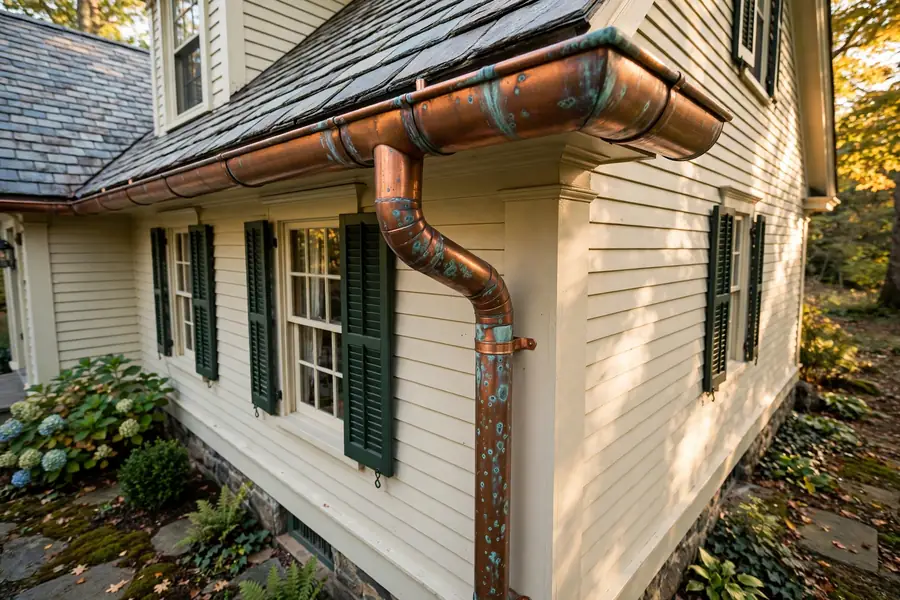
Profile changes the picture at the premium end. Half-round gutters pair naturally with copper, and half round copper gutters, also written copper half round gutters, are the classic choice on historic and Mediterranean-style homes. Round copper gutters shed debris well and suit exposed rafter tails, while k style copper gutters give you copper's lifespan in the modern profile most homes wear. Sizing rules still apply in copper: a half-round needs the 6-inch width to match a 5-inch K-style's capacity, because the round shape holds less water per inch.
Frequently Asked Questions
Direct answers to common questions.
What is the difference between 5-inch and 6-inch gutters?+
The difference is capacity. Six-inch gutters hold roughly 40 percent more water than five-inch gutters and pair with larger 3x4-inch downspouts that drain faster and clog less. The trough is one inch wider, which is barely noticeable from the street but makes a major difference during heavy rain.
Are 6-inch gutters worth the extra cost?+
They're worth it when your roof demands the capacity: steep pitches, large roof planes, valleys concentrating water into short runs, or a history of overflow during storms. For a modest single-story with a simple roofline and no overflow problems, 5-inch gutters are the correct and economical choice. The roof decides, not the price tag.
What size gutters do I need for my house?+
Gutter size depends on your roof area, roof pitch, local rainfall intensity, and how your current gutters perform in heavy rain. Steep or large roofs in North Texas often need 6-inch; smaller, simpler roofs do fine with 5-inch. An installer should measure your roof and check overflow history before recommending a size. Anyone prescribing without measuring is guessing.
Do 6-inch gutters need bigger downspouts?+
Yes. Six-inch gutters pair with 3x4-inch downspouts, which move nearly twice the water of standard 2x3-inch downspouts and resist clogging better. Installing 6-inch gutters while keeping small downspouts leaves a bottleneck that wastes the upgrade. Check both size and downspout count on any quote.
Will 6-inch gutters fit on my fascia?+
Usually yes. Six-inch K-style gutters mount to the same fascia board as 5-inch gutters. What matters is the fascia's condition: it must be solid enough to hold the heavier gutter when full of water. Installers check this during the estimate, and rotted boards get replaced regardless of gutter size.
Are bigger gutters always better?+
No. Oversized gutters on a small, simple roof add cost without benefit. The right size matches your roof's water load: enough capacity for your worst storms, without paying for volume you'll never use. Bigger is better only when the roof actually delivers more water than the smaller size can move.
What's the difference between K-style and half-round gutters?+
K-style gutters have a flat back and decorative front, mount flush to the fascia, and carry more water per inch of width. They're the standard on most homes. Half-round gutters are a smooth half-circle suited to historic or high-end architecture, but they carry less water at the same width and typically cost more.
Do I need 6-inch gutters in Texas?+
Not every Texas home needs them, but our intense storm bursts make capacity more important here than in milder climates. Homes with steep roofs, large roof planes, or overflow staining are strong candidates. Homes with modest single-story rooflines and no overflow history usually do fine with properly installed 5-inch gutters and adequate downspouts.
Are copper half-round gutters a good choice in North Texas?+
They can be, on the right house. Copper half-round gutters shrug off our sun and storms for generations and suit historic or Mediterranean architecture. The cautions are cost, the wider 6-inch size needed to match K-style capacity, and finding an installer who solders copper. On a standard suburban roofline, aluminum K-style does the same job for far less.